Have you ever noticed feeling anxious after a quick poor quality meal – or surprisingly calm after a nourishing one? Or how some foods make you feel terrible but your friends seem fine? Science is increasingly clear: what you eat directly impacts how you feel. And it may have more to do with those tiny microbes living in your gut than your own biology. These microbes play a big role in digestion and mood and communicate with us via the powerful biological networks known as the gut–brain axis.
Understanding this connection can be transformative. When you understand how your daily food choices can influence your mood, stress levels, and even long-term mental health.
What Is the Gut-Brain Axis?
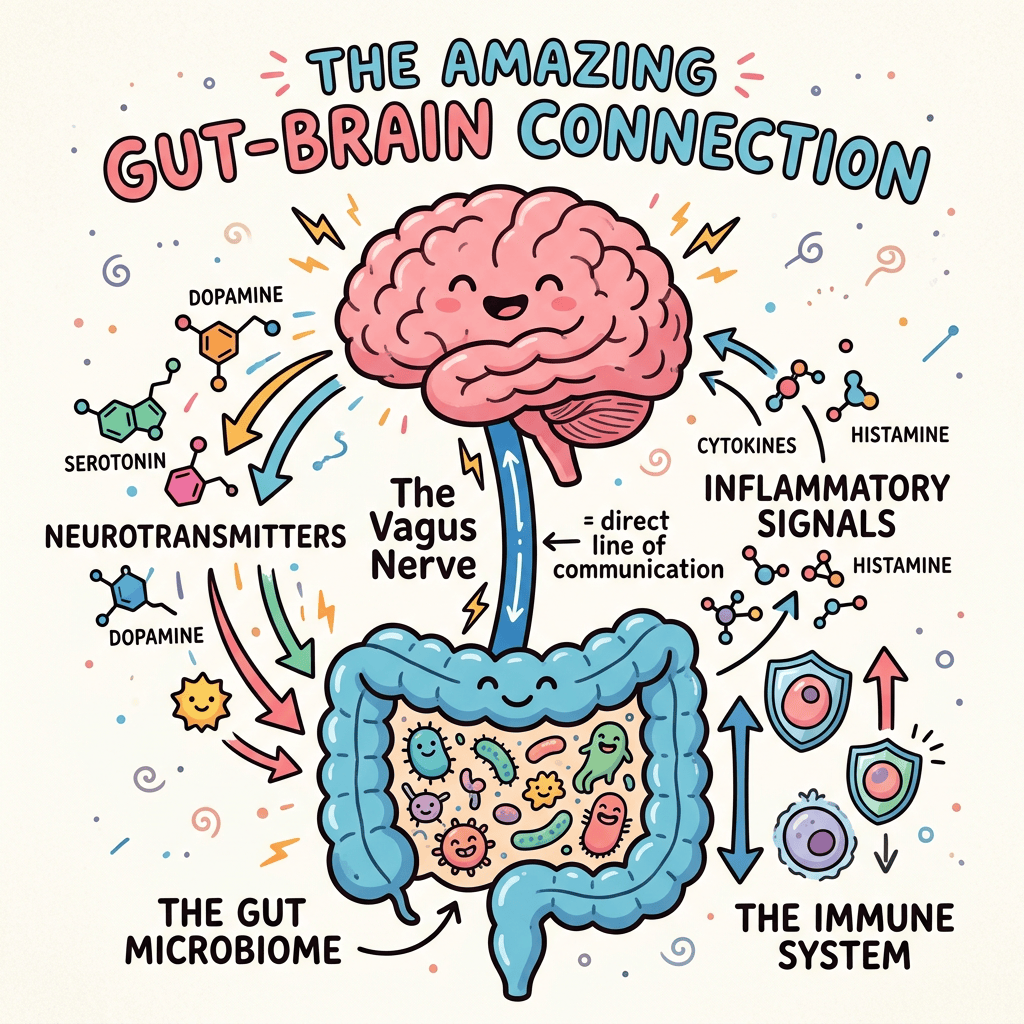
The gut–brain axis is the communication network linking your digestive system and your brain. This connection operates through multiple pathways:
- The vagus nerve, a direct line of communication between gut and brain
- Neurotransmitters, like serotonin and dopamine
- The immune system, through inflammatory signals like cytokines and histamine
- The gut microbiome, the trillions of bacteria living in your digestive tract
In fact, about 90% of serotonin, your “feel-good” neurotransmitter, is produced in the gut. This is why your digestive health plays such a critical role in emotional wellbeing. Fun fact; This serotonin then increases signalling in the brain, but does not directly travel to the brain.
Your Microbiome and Your Mood Regulation
Your gut is home to trillions of microorganisms that collectively form your microbiome. These microbes do much more than digest foods, they actively influence your brain.
A balanced microbiome can:
- Support stable mood and emotional resilience
- Reduce inflammation linked to anxiety and depression [1]
- Improve stress response through the nervous system
An imbalanced microbiome, on the other hand, has been associated with:
- Increased anxiety and low mood
- Brain fog and fatigue
- Heightened stress sensitivity
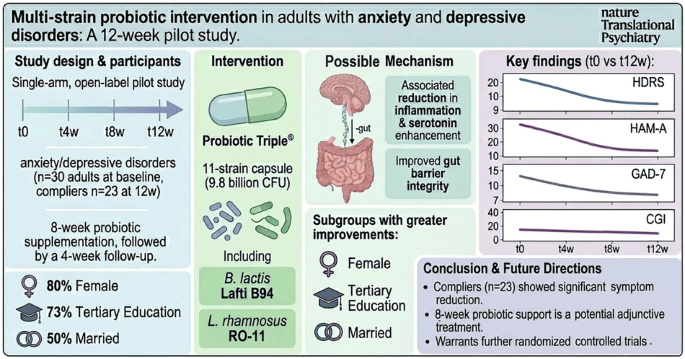
This is why two people can eat the same foods but feel completely different afterward – their microbiomes are unique. This 2022 randomized controlled study compared patients with current depressive episodes who took a multi-strain probiotic supplement or a placebo over 31 days additionally to treatment-as-usual. They found that add-on probiotic treatment completely alleviated depressive symptoms, along with changes in the gut microbiota and brain. Incredible!
A similar, more recent study has found similar results in improving depression with probiotics, and provided this graphic to help explain the mechanisms. [Ovadia et al. 2026]
Food as Information for Your Brain
Every meal sends signals to your brain. Certain foods can either support or disrupt this communication.
Mood-supportive foods include:
- Fiber-rich plants that feed beneficial gut bacteria
- Fermented foods that introduce healthy microbes
- Healthy fats that support brain function (poly and mono-unsaturated fats NOT saturated fats)
- Protein sources that provide amino acids for neurotransmitters
Mood-disrupting patterns may include:
- Highly processed foods
- Excess sugar or saturated fat intake
- Chronic under-eating or nutrient deficiencies
- Food sensitivities that trigger inflammation (likely induced via intestinal permeability)
Over time, these dietary patterns shape your microbiome, and your mental health.
Microbes and mood regulation:
Many neurotransmitters are made in your gut! 50% of your dopamine, 90% of your serotonin and 30% of GABA. However, this does not mean these get transported to the brain. Instead they work indirectly on the brain. For example, gut-derived serotonin mostly acts locally, regulating motility, secretion and gut-brain signalling via the vagus nerve, rather than crossing directly into the brain. [2]
Yano et al. (2015) showed that spore-forming bacteria promote serotonin synthesis, partly through metabolites such as short-chain fatty acids and secondary bile acids. [3]
So what’s going on here besides higher neurotransmitter production in the gut? Recent research has uncovered the role of tryptophan metabolism, immune signalling, and the importance of the gut lining. Tryptophan is an essential amino acid we get only from food, and in the gut it sits at a crossroads. It can take three pathways:
- The serotonin pathway. Enterochromaffin cells in the gut lining convert a small share of tryptophan into serotonin (5-HT), and the gut makes roughly 90% of the body’s serotonin. Gut microbes influence this step.
- The kynurenine pathway involves handling the large majority of tryptophan that is broken down. When inflammation is present in the intestines, this drives tryptophan toward kynurenine. Some downstream metabolites, like kynurenic acid, appear neuroprotective, while others, like quinolinic acid, can be neurotoxic and have been linked to depression and neuroinflammation [4]. When the gut is inflamed or stressed, more tryptophan gets diverted here, which leaves less for serotonin and indole production.
- The microbial indole pathway. Bacteria such as Lactobacillus, Clostridium sporogenes and some Bacteroides convert tryptophan into indole derivatives, including indole-3-propionic acid (IPA), which can:
- support mucosal defence
- strengthen the intestinal barrier and dampen inflammation
These indoles are made only when the right microbes are present, so they are a direct readout of microbial function [5]
Why the gut lining matters. A healthy barrier keeps bacterial fragments such as LPS out of circulation, and indoles help maintain it. When diversity drops or the lining is compromised, immune activation rises, and tryptophan is pulled toward kynurenine. The balance between the three pathways is a feedback loop between microbes, immunity and the gut wall [6].
Why functional stool testing can help
Standard blood work rarely tells you where tryptophan is going. A functional stool test can provide indirect clues, including:
- Microbial composition and diversity: the presence or depletion of indole-producing and spore-forming taxa.
- Short-chain fatty acids (e.g. butyrate): these support the barrier and enterochromaffin cell serotonin production.
- Inflammation markers (calprotectin, lactoferrin) and secretory IgA: these suggest an immune environment that favours kynurenine diversion.
- Digestive and barrier-related markers (such as elastase, or zonulin on some panels), which give context on gut lining health.
- Some panels report indole or related metabolites, though this varies by lab. I usually stick to a pretty simple test that maps your microbial DNA to functional outputs like neurotransmitters, vitamins, and short-chain fatty acids.
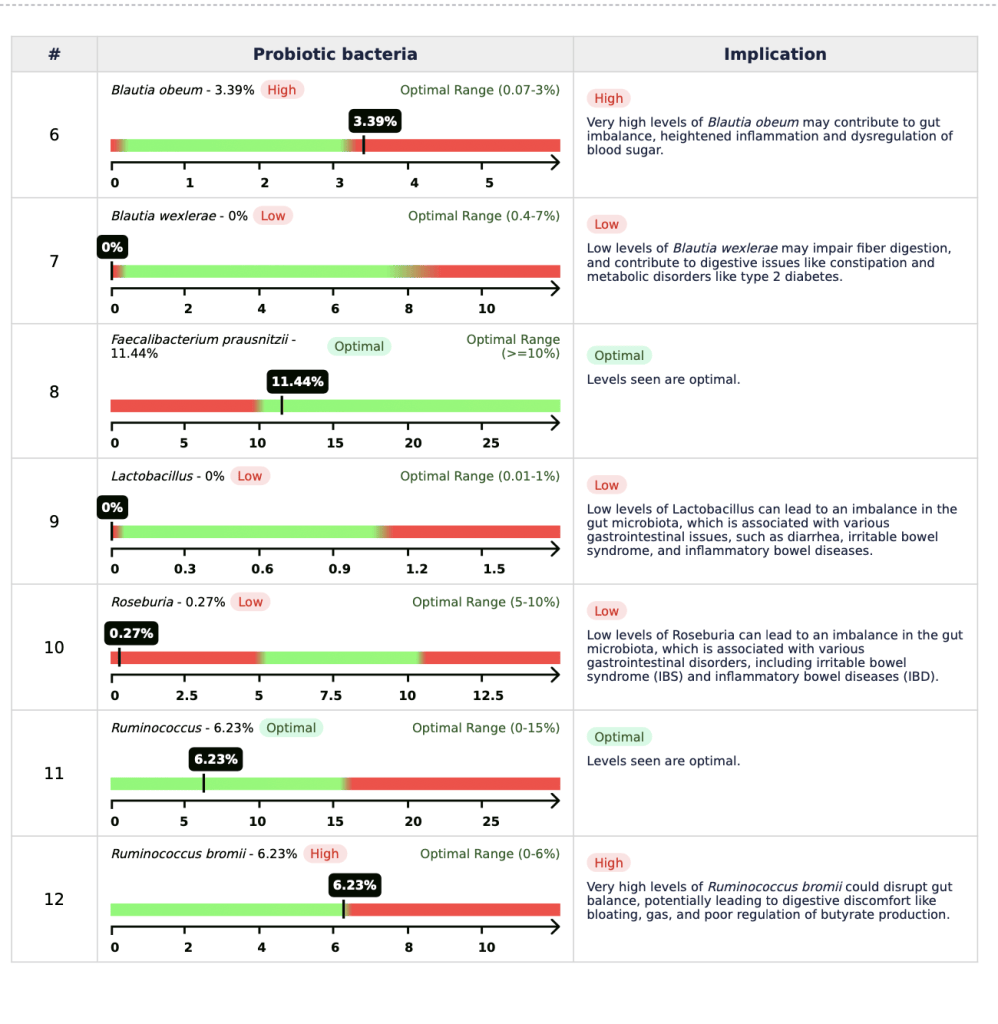
Together these form a picture of whether the gut environment supports balanced tryptophan signalling. Patterns can point to targeted dietary, fibre and lifestyle strategies, and retesting can show whether they are working. Here’s a screenshot of one of my favourite stool testing reports showing which bacteria are out of range.
The Role of Personalization: Why One-Size-Fits-All Doesn’t Work
There is no universal “perfect diet” for mood. Everyone’s genetics, history, and microbiome are unique.
Your response to food is influenced by:
- Your genetics
- Your gut microbiome composition
- Your lifestyle and stress levels
This is where personalized testing becomes incredibly valuable.
Through advanced DNA and stool testing, you can uncover:
- How your body processes nutrients
- Which foods may support or hinder your mental wellbeing
- The current state of your gut microbiome
With this data, nutrition shifts from guesswork to precision. So you may be wondering, how do I make sure my microbiome is receiving all of these benefits? What strains of probiotics actually make a difference in my mood? Which strains are best for which conditions? The answer is again highly individualized, which is why testing can help pinpoint the most effective nutritional and microbial changes needed to shift your microbiome. Not all probiotics on the market are clinically studied or reliable. Quality matters.
However, there are some general principles and findings that apply to the average person. Focusing on high-quality, nutrient dense diverse plant foods, healthy poly-unsaturated fats, lean protein, omega-3s, and probiotic foods is a good starting point.
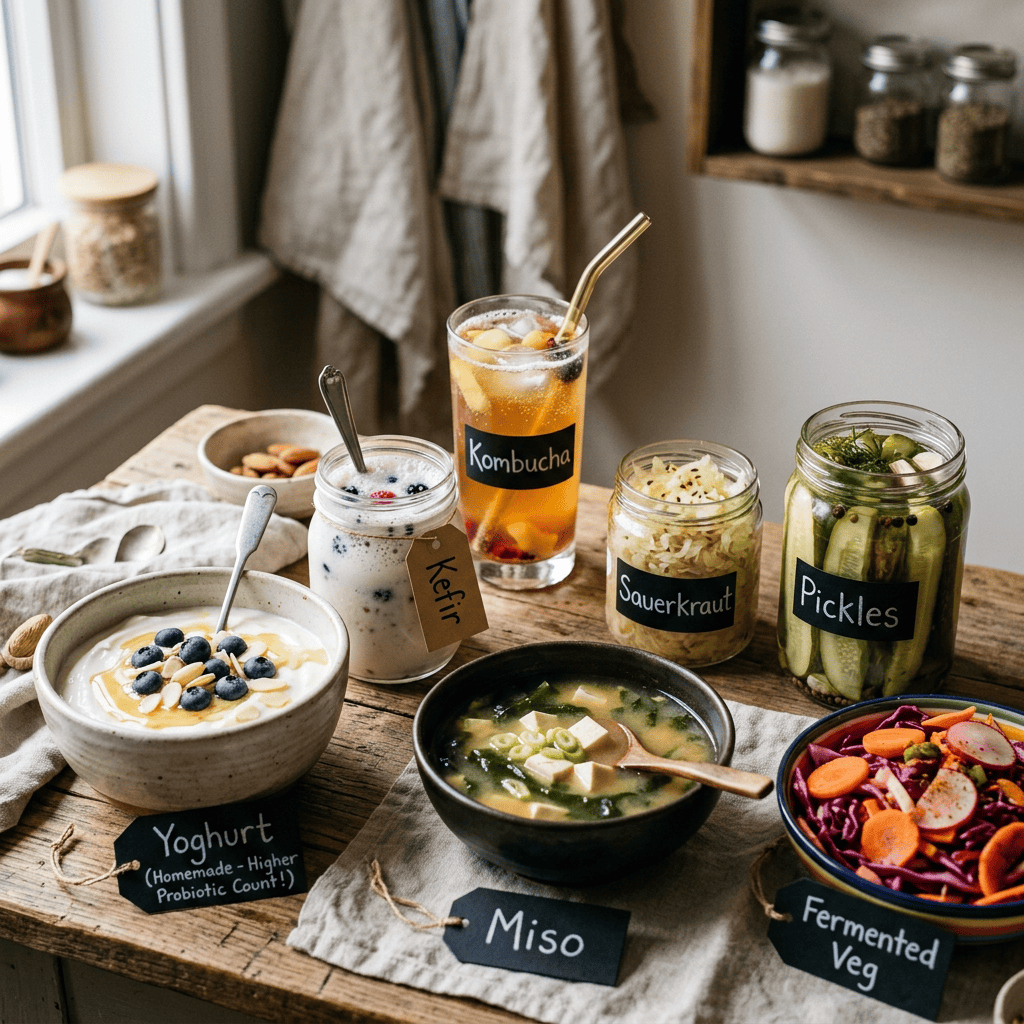
Some of the best probiotic foods that actually taste great:
- Yoghurt (sugar-free, plain, whole fat yoghurt is best). Try making some at home for a MUCH higher probiotic count.
- Kefir dairy or non-dairy options are great (same as above)
- Kombucha (but in small amounts as it tends to be high in sugar)
- Saurkraut. Cheap, easy to make, also high in prebiotic fibre.
- Pickles (in the refrigerator section at the grocery store)
- Any form of fermented vegetables (again refrigerated kind is best)
- Miso. Miso soup is a powerhouse for your microbes! Just be sure to add the miso to the soup at the very end of cooking, as excess heat can kill off some of the microbes.
- Natto. Fermented soybeans. For those who are brave…
Turning Research Insights Into Action
Understanding your gut–brain connection is the first step. Real change happens when you apply these findings to your daily life.
Start by:
- Prioritizing whole, nutrient-dense foods
- Supporting your microbiome with fiber and diversity
- Eating 1-3 servings of probiotic foods per day (as tolerated)
- Managing stress through nervous system regulation
- Paying attention to how foods make you feel, both physically, and emotionally
Then, take it a step further with personalized insights that align your biology with your lifestyle. If fibre is causing more trouble than relief, this is exactly the area I specialize in as a gut-brain nutritionist. Sometimes fibre can make constipation and bloating worse. In these cases, other personalized short-term approaches can resolve the fibre conundrum.
The Future of Mental Wellness Is in the Gut
Mental health is no longer just about individual genetics and psychology. It’s about the entire ecosystem of microbes, nutrients, and metabolism. The gut–brain axis shows us that food is not just fuel; it’s information, communication, and medicine.
By understanding your unique biology through microbiome testing, you gain the ability to support your mood in a targeted, sustainable way.
Because when your gut is supported, your mind follows.
I would be happy to assist you in uncovering ways of improving your microbial health inside my gut restoration nutrition coaching services. As a holistic nutritionist (CNP) I help people understand what factors may be driving their chronic symptoms, and how to approach them with a holistic nutrition, mind-body and herbal medicine focus. If you want to learn more about working with me, please see my services page here and book a session. Thanks!
Take care and trust your gut,
Heather 🙂
References:
- Schaub, A. C., Schneider, E., Vazquez-Castellanos, J. F., Schweinfurth, N., Kettelhack, C., Doll, J. P. K., Yamanbaeva, G., Mählmann, L., Brand, S., Beglinger, C., Borgwardt, S., Raes, J., Schmidt, A., & Lang, U. E. (2022). Clinical, gut microbial and neural effects of a probiotic add-on therapy in depressed patients: a randomized controlled trial. Translational psychiatry, 12(1), 227. https://doi.org/10.1038/s41398-022-01977-z
- Strandwitz P, Kim KH, Terekhova D, Liu JK, Sharma A, Levering J, McDonald D, Dietrich D, Ramadhar TR, Lekbua A, Mroue N, Liston C, Stewart EJ, Dubin MJ, Zengler K, Knight R, Gilbert JA, Clardy J, Lewis K. GABA-modulating bacteria of the human gut microbiota. Nat Microbiol. 2019 Mar;4(3):396-403. doi: 10.1038/s41564-018-0307-3. Epub 2018 Dec 10. PMID: 30531975; PMCID: PMC6384127.
- Yano JM, Yu K, Donaldson GP, Shastri GG, Ann P, Ma L, Nagler CR, Ismagilov RF, Mazmanian SK, Hsiao EY. Indigenous bacteria from the gut microbiota regulate host serotonin biosynthesis. Cell. 2015 Apr 9;161(2):264-76. doi: 10.1016/j.cell.2015.02.047. Erratum in: Cell. 2015 Sep 24;163:258. PMID: 25860609; PMCID: PMC4393509.
- Kennedy, P. J., Cryan, J. F., Dinan, T. G., & Clarke, G. (2017). Kynurenine pathway metabolism and the microbiota-gut-brain axis. Neuropharmacology, 112(Pt B), 399–412. https://doi.org/10.1016/j.neuropharm.2016.07.002
- Roager, H.M., Licht, T.R. Microbial tryptophan catabolites in health and disease. Nat Commun 9, 3294 (2018). https://doi.org/10.1038/s41467-018-05470-4
- Agus, A., Planchais, J., & Sokol, H. (2018). Gut Microbiota Regulation of Tryptophan Metabolism in Health and Disease. Cell host & microbe, 23(6), 716–724. https://doi.org/10.1016/j.chom.2018.05.003

